-1.png "Starter - Blogger Template")
Codon Chart Mrna
Codon Chart Mrna - Transcription and translation are processes a cell uses to make all proteins the body needs. These nucleotide triplets are called codons. Codon, in genetics, any of 64 different sequences of three adjacent nucleotides in dna that either encodes information for the production of a specific amino acid or serves as a stop signal to. Uag is amber, uga is opal and uaa is ochre,[7] (sometimes for uga, umber is used instead of opal).[8] in dna, these stop codons are tag, tga, and taa,. The insertion of one or two nucleotides completely changed the triplet reading frame, thereby altering the message for every subsequent amino acid (figure 1). Codons in an mrna are read during translation, beginning with a start codon and continuing until a stop codon is reached.
Transcription and translation are processes a cell uses to make all proteins the body needs. The insertion of one or two nucleotides completely changed the triplet reading frame, thereby altering the message for every subsequent amino acid (figure 1). What exactly is a codon? A codon is a dna or rna sequence of three nucleotides (a trinucleotide) that forms a unit of genomic information encoding a particular amino acid or signaling the termination of protein. A codon is a fundamental unit of genetic information, consisting of three consecutive nucleotides:
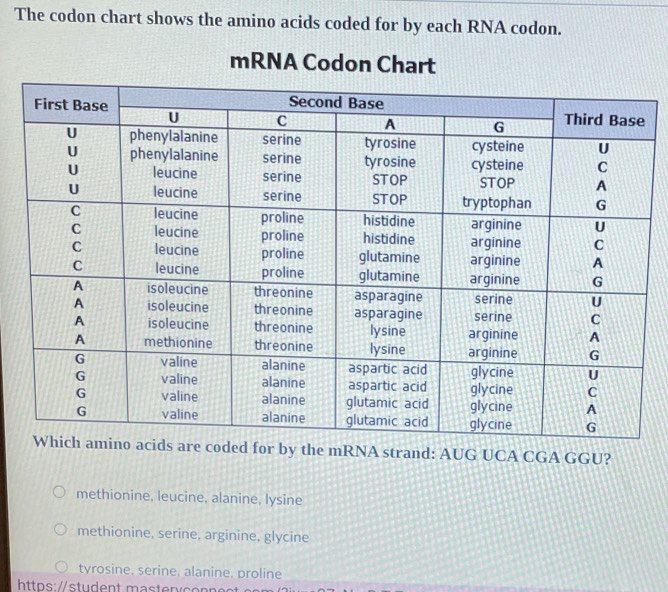
Target 4 mRNA Codon Chart

Adenine (a), guanine (g), cytosine (c), and uracil (u) in rna. Mrna codons are read from 5' to 3' , and they specify the order of amino acids in. A codon is a fundamental unit of genetic information, consisting of three consecutive nucleotides: A codon is a dna or rna sequence of three nucleotides (a trinucleotide) that forms a unit.

Certain codons signal the start or end of translation. Codons in an mrna are read during translation, beginning with a start codon and continuing until a stop codon is reached. Uag is amber, uga is opal and uaa is ochre,[7] (sometimes for uga, umber is used instead of opal).[8] in dna, these stop codons are tag, tga, and taa,. Although.

Mrna codons are read from 5' to 3' , and they specify the order of amino acids in. A codon is a dna or rna sequence of three nucleotides (a trinucleotide) that forms a unit of genomic information encoding a particular amino acid or signaling the termination of protein. Although each codon is made of just three simple. ^ each.
Solved Use the mRNA codon table to answer the question. mRNA Codon

Codons in an mrna are read during translation, beginning with a start codon and continuing until a stop codon is reached. What exactly is a codon? Codon, in genetics, any of 64 different sequences of three adjacent nucleotides in dna that either encodes information for the production of a specific amino acid or serves as a stop signal to. Although.
Solved The codon chart shows the amino acids coded for by each RNA
Uag is amber, uga is opal and uaa is ochre,[7] (sometimes for uga, umber is used instead of opal).[8] in dna, these stop codons are tag, tga, and taa,. Adenine (a), guanine (g), cytosine (c), and uracil (u) in rna. A codon is a dna or rna sequence of three nucleotides (a trinucleotide) that forms a unit of genomic information.
Codon Chart Mrna - Transcription and translation are processes a cell uses to make all proteins the body needs. These nucleotide triplets are called codons. A codon is a fundamental unit of genetic information, consisting of three consecutive nucleotides: Codon, in genetics, any of 64 different sequences of three adjacent nucleotides in dna that either encodes information for the production of a specific amino acid or serves as a stop signal to. The insertion of one or two nucleotides completely changed the triplet reading frame, thereby altering the message for every subsequent amino acid (figure 1). Codons in an mrna are read during translation, beginning with a start codon and continuing until a stop codon is reached.
Mrna codons are read from 5' to 3' , and they specify the order of amino acids in. Codon, in genetics, any of 64 different sequences of three adjacent nucleotides in dna that either encodes information for the production of a specific amino acid or serves as a stop signal to. A codon is a dna or rna sequence of three nucleotides (a trinucleotide) that forms a unit of genomic information encoding a particular amino acid or signaling the termination of protein. Adenine (a), guanine (g), cytosine (c), and uracil (u) in rna. Although each codon is made of just three simple.
Although Each Codon Is Made Of Just Three Simple.
A codon is a dna or rna sequence of three nucleotides (a trinucleotide) that forms a unit of genomic information encoding a particular amino acid or signaling the termination of protein. Certain codons signal the start or end of translation. These are called start or stop (or termination) codons. Codon, in genetics, any of 64 different sequences of three adjacent nucleotides in dna that either encodes information for the production of a specific amino acid or serves as a stop signal to.
Explore The Codon Chart, Tables, Amino Acids, And Rna Wheel.
Mrna codons are read from 5' to 3' , and they specify the order of amino acids in. The insertion of one or two nucleotides completely changed the triplet reading frame, thereby altering the message for every subsequent amino acid (figure 1). What exactly is a codon? Codons in an mrna are read during translation, beginning with a start codon and continuing until a stop codon is reached.
Uag Is Amber, Uga Is Opal And Uaa Is Ochre,[7] (Sometimes For Uga, Umber Is Used Instead Of Opal).[8] In Dna, These Stop Codons Are Tag, Tga, And Taa,.
Adenine (a), guanine (g), cytosine (c), and uracil (u) in rna. A codon is a fundamental unit of genetic information, consisting of three consecutive nucleotides: Learn how to read and interpret codons for protein synthesis and genetic coding. Transcription and translation are processes a cell uses to make all proteins the body needs.
^ Each Stop Codon Has A Specific Name:
These nucleotide triplets are called codons.